Sunday, August 7, 2011

Angkor Babies, Day II: Angkor What?

Siem Reap, Cambodia, 8/7/11

"I was very young during the reign of the Khmer Rouge in the late 1970s. I remember one night my family was sitting down at the kitchen table enjoying dinner when we heard gunfire and explosions coming from outside. We immediately sought shelter in a small underground bunker, hidden through a trap door under the floor. Such shelters were quite common during the late 70s. My whole family huddled together in the cramped space as the roar of ammunition raced above us. We sat there preying the officials would not find us or destroy our house. Hours passed and the gunfire eventually ceased. We climbed back up to thankfully find our home fully intact. Our meal, however, suffered a much worse fate, as when we were underground our dog helped himself to quite a feast."  - Angkor Wat Guide, 8/7/11


This is just one story in what was one of the worst examples of genocide in recent history, killing nearly one third of the Cambodian population from 1975 - 1979. As our terrific guide at Angkor Wat recites the tale, his consistently affable manner turns ferociously serious and his expression becomes stoic. Although the harrowing anecdote presents the atrocities of the Khmer Rouge in an overly intimate manner, I am impressed how he ends the story on a bright and humorous note to which any dog lover can relate. That he can find humor during a period of nonstop brutality truly represents the strength and resilience of the Cambodian people. A community of strong, united, patriotic citizens despite the fact that their country was on the brink of complete destruction just three short decades ago.

***

It's our second and final day visiting the Temples of Angkor and we've saved the best for last. Our attempt to wake up for the sunrise at Angkor Wat proved futile but, due to the overcast weather, supposedly the sight left much to be desired. After the rudeness and general hostility of yesterday's tuk-tuk driver, we make sure today's is a more optimal choice. We get lucky with "Mr. Black," a tall, slightly oafish Siem Reap local who wears a wide grin, his smile almost extending to his eyes. Mr. Black is knowledgeable, genial, and laid back, a welcome change from yesterday. We grab a quick breakfast of pastries from a big red shop set along a strip mall composed exclusively of bakeries. No one speaks English but I still have success ordering fluffy cinnamon raisin danish with a slightly odd wheat-flavored green tea.

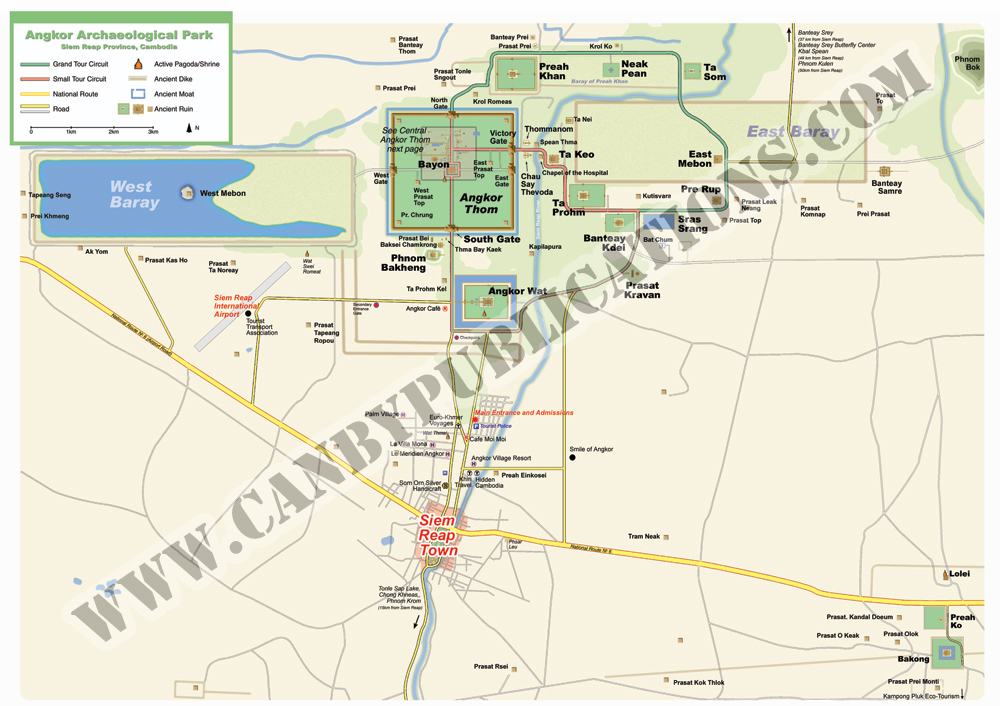
Angkor Wat, meaning "City Temple", is the world's largest religious site and one of the original Ancient Wonders of the World (although the youngest at a sprightly 900 years). The temple is Cambodia's premiere attraction, it's national symbol (found on the country's flag), and a triumph of Khmer ingenuity and architecture. Angkor Wat was designed to represent Mount Meru, the sacred mountain home to many Buddhist and Hindu deities, with five central towers representing the mountain's five summits. Angkor Wat is bordered by a large moat and the temple itself lies in the center of a island surrounded by dense trees. The temple grounds make up roughly 200 acres.

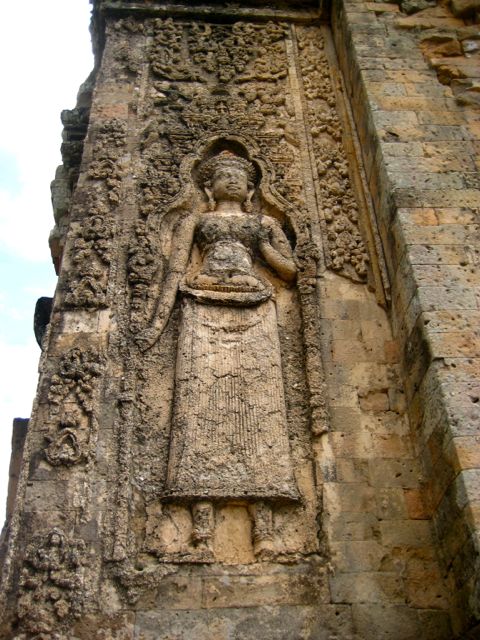
The complex was built in the 12th Century by King Suryavarman II and, although scholars estimate it would take 300 years to build today, the construction only roughly thirty-seven years to complete. Approximately 38,000 Cambodians worked on the construction plus 4,000 elephants. Angkor Wat's stone were found in a quarry at Mount Kulen, roughly twenty-five miles away from the site and transported down the SIem Reap River. The temple is predominantly composed of sandstone, almost all of which is carved into ornate bas-reliefs and friezes. One of the most landmark friezes is a scene of the Churning of the Sea of Milk, an epic good versus evil battle fought by Buddhist and Hindu gods as they battle to harvest the elixir of immortality from the sea. There are 1,796 devata carvings spread across the temple grounds. Devatas are sacred Buddhist female guardian angels and each deva in Angkor Wat has a different hairstyle and dress. Other reliefs depict giant tortoises, dragons, unicorns, griffins, elephants, and lavish dancer.

We explore the lavish grounds with our incredibly informative guide who not only possesses the encyclopedic knowledge of every frieze and pagoda, but has an uncanny knack for great photo opportunities. He is like a walking Natural History Museum. He points out bullet holes and grenade explosion craters from the Khmer Rouge's unsuccessful attempts to destroy the mighty temple during the late 1970s. The entire site is magical and, due to the low season, surprisingly quiet. We spend hours walking around, admiring the bas-reliefs and friezes, which are so precise they seem as if they were carved with needles, learning ancient Khmer mythologies. One section of the temple houses four small swimming pools laid out in a 2x2 grid. Suryavarman had a daily ritual of bathing in the pools and then retreating to the "echo chamber," a small stone room roughly the size of an airplane bathroom. The king would stand and pound on his chest with both hands, creating a reverberating echo that representing his sins and disease leaving his body. Amit, Louise, and I all connect with our inner royal by beating our chests, hearing our sins rush out of our bodies and echoing throughout the small chamber. Oddly the echo only works when you beat the center of your chest, other parts of the body or shouting do not work.

Angkor Wat entrance and moat


One of the many deva statues, each with different headdresses

Outside Angkor Wat with a naga


Boo, scaffolding


Lions guarding the temple


Drinking a fresh coconut with Angkor Wat looming behind

Seven-headed naga statue


Fish-sicles


Fish popsicle in a grocery store in Cambodia

Or maybe I should call it a "fish-sicle" or a "fish-wich." Maybe "frozen fish-fection?"

Either way, they're obviously successful in Cambodia as they've been going strong since 1991.

Saturday, August 6, 2011

Let Them Eat Python

Siem Reap, Cambodia, 8/6/11

Does it demonstrate a lack of culture to claim that Cambodian python tastes like chicken? Is my palette juvenile or untrained if I think the Southeast Asian reptile tastes identical to the ubiquitous poultry?

I don't care what critics say, the resemblance is uncanny.


Angkor Babies

Siem Reap, Cambodia, 8/6/11

Cambodia's Angkor era lasted from 802 - 1432 AD, started when Hindu King Jayavarman II proclaimed himself the "god-king" and "universal monarch." Under Jayavaraman's rule, the Angkorian Empire conquered most of modern day Cambodia, engaged in relentless wars against Siam (modern-day Thailand), and built some of the most spectacular cities and religious complexes known to man. After a prosperous six centuries, the Angkor Empire eventually fell due to a combination of environmental devastation (droughts, failed irrigation, earthquakes, massive climate change), disease (Bubonic plague) and powerful attacks by the Siamese. Although the Thais made off with priceless relics and customs, many which are visible in Thai culture today, much of the stunning Angkorian Empire is still visible today.

Angkor was considered the largest preindustrial city on Earth, encompassing over 390 square miles. The center of the complex is Angkor Wat, the largest religious site on the planet and one of the original Wonders of the World (despite being a young 900 years old). Most of the temples reside a few miles outside Siem Reap city, situated along the Tonle Sap lake. There are over one thousand temples that make up the ancient Khmer Empire and the area has been designated as a UNESCO World Heritage Site.


Seeing all the major temples of Angkor takes at least three days, more typically a week, and we only have two days. As such, Amit and I are up early on day one to explore the "Grand Circuit", a tour of a half dozen of the smaller temples found in central Angkor. Our tuk-tuk driver from the night before was hostile and unfriendly and we are surprised that, when we ask our hotel concierge to hire a different driver, the same man shows up out front. Oh well, time is of the essence. It's a beautiful day as we leave Siem Reap city and head into the forest that leads to the temples.

Our first stop is Pre Rup, an ancient funeral site literally meaning "turn the body." Built in 961 AD, Pre Rup is composed of three brick, laterite, and sandstone triangular stupas. When the temple was operational at the turn of the millennium, ashes of the deceased were ritually rotated in different directions, giving the temple its name. As with most Khmer temples, Pre Rup is protected by imposing stone lions, with ornately tiled manes. Although Pre Rup is over a thousand years old, the carvings are incredibly intricate and well-preserved today -- statues of queens in jeweled crowns engraved into the sandstone temples walls.


Pre Rup entrance


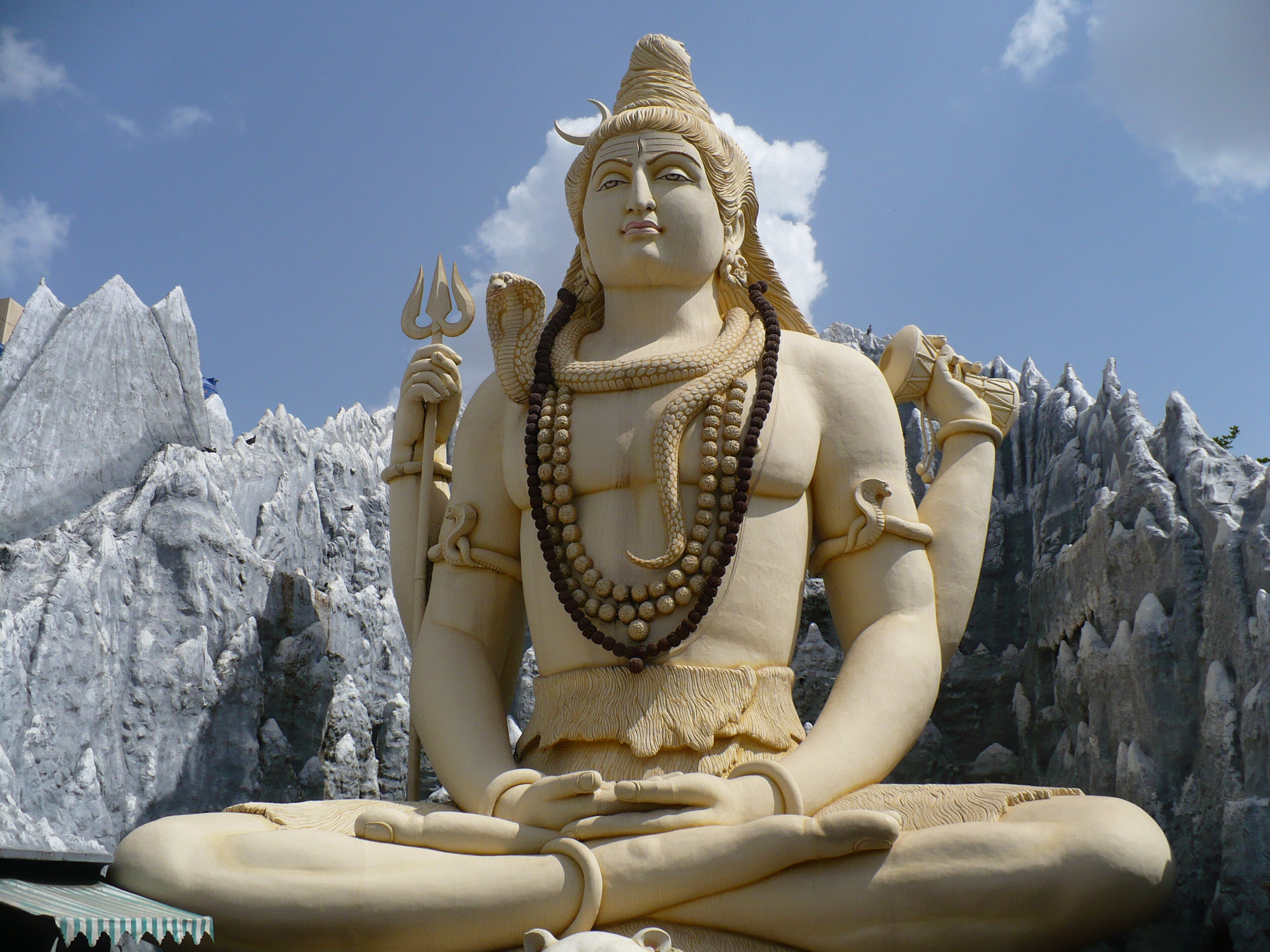
East Mebon is next along the tour, a small gray temple complex also guarded by formidable roaring lion statues. King Rajendravarman completed the table in 953 AD, dedicated to his father. The temple is meant to honor the four-armed Hindu destroyer god Shiva, who typically carries a trident, bongo drum and wears a crescent moon on his head and pythons as necklaces. In addition to the lions, East Mebon, an array of six foot-tall sandstone elephants also protect the temple

Shiva (from Google)


East Mebon entrance


Farther north, across the Siem Reap River is Ta Som, a small narrow temple built by King Jayavarman II at the end of the 12th Century and dedicated to his father. At either end of the temple are two large gopuras, or entrance ways, decorated with four faces each respectively pointing north, south, east, and west. After 900 years, the brick gopuras are heavily oxidized and covered in moss, giving the entrance ways a gray and white dappled aesthetic. The eastern entrance has been overtaken by a large strangler fig tree, which appears to be growing directly out of the temple entrance. The strangler tree resembles a large cluster of disorganized weeds made out of tree branches. The tree limbs completely obscure the majestic faces found on the eastern gate and almost look as if they are trying to topple the entrance to the ground. True to its name, it seems to be strangling the poor ancient temple. In the long pathway between the two entrances are several ancient libraries, pavilions, and sanctuaries. As we pass through, admiring the carvings and ancient craftsmanship, we are approached by dozens of grade school-aged Cambodian children selling postcards, art prints, fans, and t-shirts. Others forgo salesmanship and instead opt for different routines designed to impress tourists into relinquishing cash. Around the Angkor circuit, these tricks typically include reciting the entire alphabet in a dozen different languages, singing Western pop songs, dictating every American state in alphabetical order, or trying to stump visitors in a game of "name that country's capital." The combination of these kids' intelligence, memory retention, and extroversion would make them ideal mates if only they were twenty years older, female, single, and lived in New York.

Ta Som


"Ask me a capital! Any capital!"

Neak Pean is a Buddhist temple on a small circular island located in the center of a man-made lake, built by King Jayarvarman II. The name literally means "The Entwined Serpents" as the central sanctuary is surrounded by multi-headed serpents. The temple originally acted as a hospital, its waters believed to have healing powers (although, as the water today is covered in moss and algae, I'm not too sure what kind of healing powers still exist. Maybe if one believes in the curing power of leeches). The central lake is surrounded by four small pools representing earth, wind, water, and fire. Four chapels mark the entrances to each pool: human chapel, lion chapel, elephant chapel, or horse chapel, although most of the statues have become ruins over time. On the small central island, the main stupa shares real estate with a statue of Balaha, the sacred Buddhist horse known for saving drowning sailors. Too bad I'm not going for a swim as I like riding horses. I'm all for anthropomorphic horses and equi lifeguards but as I have yet to meet Balaha I would have to say my favorite is still Mr. Ed. Sorry, Balaha.


Neak Pean


Central sanctuary with Balaha to the right

I say a little prayer for you


Moving along, we arrive at Preah Khan, meaning "Sacred Sword," a large flat temple built by King Jayarvarman VII in 1191 in dedication to his father. The temple makes up 138 acres surrounded by a moat. When it was operational, over 100,000 workers and servants resided on the grounds. Preah Khan served a dual role as a city and a Buddhist university, employing 1,000 teachers and 1,000 dancers.The complex is modeled after a modern compass, the center of which is a small ceiling-less room that reflects the sun onto a domed stupa shrine, symbolizing Buddhism in all its glory. The temple grounds have long hallways decorated with intricate carvings depicting ancient kings, monks, Buddhist gods, and naga serpents. There are shrines to over 430 deities, each of which received food, mosquito nets, perfume and clothing. The temple has a long causeway, with giant stone statues holding a massive naga serpent; on one side Buddhist golds hold the five-headed snake-like creature, on the other, the reptile is held by evil Hindu asura deities. Walking along the bridge is like being embroiled in a mythological battle of good and evil. We pass by the Hall of Dancers, a small building with carvings of rows of female dancers who entertained the gods.


Carving depicting the Battle of Lanka


Hall of Dancers


Garuda (Mythical man-bird creature) holding a Naga


We're heading to Phnom Bakheng to watch the sun set and drive straight through Angkor Thom, one of the biggest individual temples among the city on Angkor. As we exit the South Gate, one of Banyon's four-sided stone faces smiles back at us, looking forward to our formal return tomorrow. Angkor Thom's South Gate is protected by hordes of grey monkeys. The primates have the decency not to enter the sacred Khmer ruins, but that tact certainly does not stop them from climbing on top of cars and small children, stealing food, and defecating on street vendors.


Phnom Bakheng is one of the highest buildings in central Angkor and is a popular tourist destination for watching the sun set; so much so, that security guards close the entrance after enough hundreds have already poured in. We walk up a a forest path to reach the summit while those with bad legs, or large wallets, ride elephants draped in silk. Phnom Bakheng is known as the "Temple Mountain" and was constructed at the end of the 9th century by King Yasovarman. The site, which was dedicated to Shiva, was the prime religious temple within Angkor prior to Angkor Wat's construction. When we reach the temple, the sky is heavily overcast and the sun set is a bit of a let down. That said, the top offers terrific views of Angkor Wat in the distance and Amit and I run into Chris and Jen, the two Scots from the Treehouse Seven. Phnom Bakheng is almost completely surrounded by dense forest, with pockets of gray brick and sandstone temples peaking out, as if they're hiding in the jungle. Thus, it's really no surprise that many of the temples of Angkor spent centuries hidden under dense jungle overgrowth, only to be discovered by explorers and scientists in the past 300 years.

Phnom Bakheng