Showing posts with label Vietnam. Show all posts

Wednesday, August 3, 2011

Oodle Your Noodle

Ho Chi Minh City, 8/2/11 - 8/3/11

I meet Yom and Ashley for a big bowl of Pho at Pho Hao, recommended by 1,000 Things To Do Before You Die. The book is almost entirely devoted to key places to visit and adventures to conquer around the world, but surprisingly recommends checking out a tiny hole-in-the-wall noodle soup shop in the Southern Vietnamese city.

Mixed meat pho at Pho Hoa


The signature soup combines brisket, flank steak, pork balls, tripe, thick rice noodles, and a rich broth. Ashley and I share a large bowl, adding in lettuces, fresh herbs, chilis, garlic, fresh lime and dipping in large fried dough breadsticks. The three-story restaurant is quite busy although it's late in the afternoon. What it lacks in atmosphere (bright fluorescent lights, plastic tables and chairs) it makes up with its food. The broth has a deep flavor of pork and slightly spicy and bright due to the lime and chilis. We eat it alongside steamed buns stuffed with roasted pork and hardboiled egg. The pho is so delicious that after Ashley and I polish off our large bowl I grab ahold of whatever isn't finished at the table.

The next day, I'm exploring Ho Chi Mihn City, including the Opera House, Reunification Palace (Independence Palace), Notre Dame Cathedral, and Ben Thahn Market. Lunch is more noodle soup at Pho 2000, where President Clinton dined more than a decade ago. The restaurant is covered in photos of Clinton with the staff, eating noodle soup, and waving to fans. Big magenta signs outside the restaurant exclaim they serve "Pho for the President."

Live crabs at Ben Trahn Market


Renumification Palace
Helicopter on top of the palace

Notre Dame Cathedral

Singing outside the National Opera House


Tuesday, August 2, 2011

'Tutes & the Maytals


Ho Chi Minh City, Vietnam, 8/2/11

All the bars we go to in Saigon are packed to the brim with prostitutes. Especially as the night progresses. I think it's a 2:1 ratio in the favor of the girls of the night. Even including the men. We can't avoid them, walking around in 7'' stilettos, corsets, and skin-tight metallic dresses that leave little to the imagination. The wear immense amounts of mascara, long straight perfectly-coiffed black hairstyles, and cold statuesque stares. Their preferred company seems to be older Western men, which is great for me since I don't even need to buy a ticket to watch this show.

While playing pool, we meet Will, a gregarious 31-year old Mississippian with a thick build and a crewcut of prematurely salt & pepper hair. He's not much older than me, yet is twice divorced, has a five-year old son, has served two tours of duty with the Air Force, and now lives in Taipei with his Taiwanese girlfriend of one year, Rikki. She takes a liking to me immediately and introduces me to several of her friends, all of whom are striking with painted-on dresses. Due to the company they're keeping, I believe they're different from the rest of the crowd until I get to know one better. After I've been flirting with Cindy for an hour or so, Rikki pulls me aside and shoves a giant stack of money in my face, furiously flipping through individual bills. As she fans the money, Rikki whispers in my ear, "my friend likes you. She likes you very much. You tell me what you want tonight, just let me know, and I'll tell you how much."

I think she sees the skepticism on my face so Will comes in for backup, putting his arm around me. He looks me dead in the eyes and in a thick Southern accent says, "listen man, you always pay for it one way or another. You go out on a date, you're paying her. You're in a relationship, you're paying her. This is the exact same... And this girl really likes you!" His misogynistic, antiquated logic isn't inherently flawed and I do pay for all my dates. But I don't wake up the next morning with the inability to urinate. Plus I haven't been married, let alone twice divorced, so I will let the jaded outlook wait.

Rikki keeps flashing bills in front of my face pressing about my desires for the evening, as Cindy inches closer and closer to my groin while flashing her toothy smile. I tell them both what I really want is to go to bed alone in my sixth floor tenement room with teddy bear sheets. Cindy is beautiful and should get an Oscar for her feigned interest, but at least this way I'll know for sure: If I have a rash tomorrow, it won't be from a petite, magenta dress-class, sexy lady of the night. It will be bed bugs.


War Remants Museum

Ho Chi Minh City, Vietnam, 8/2/11

Ho Chi Mihn City, formerly Saigon, shares Hanoi's endless stream of loud, confusing motorbike traffic, but has many more charms. Streets are wider, trees and parks abound and even the scammers seem more tame. The frenetic, chaotic traffic from the Northern capital remains unchanged in the Southern city.


When I arrive, nearly all the hostels are full and I can't find where Amit, Louise, and Elaine are staying. Thus, I quickly grab a private room -- spacious although on the sixth floor of a narrow walkup building above a tailor. I found this hostel after the owner sprinted up to me on the street, certainly noticing my sweat-filled brow and look of exhaustion, and insisted, "you stay with me!" Typically I do not go for these solicitations but I only had a limited time in Ho Chi Minh. There are oddly two beds in my room, each of which is compressed in the center due to wear, and the sheets are bedecked with teddy bears and flowers. One would think that owning a tailor shop below would grant thew owners accessing to finer bed fabrics, such as those with warthogs or lemurs, but I guess times were tough this year.

I immediately head to the War Remnants Museum which is like Hanoi's Prison Museum in its overwhelming biased, propagandist feel, yet about 5,000 times more horrific. The first floor is a cake walk, depicting all the countries around the world that protesting the war, illuminating some of the key demonstrations, and showing notable war planes and tanks. Ironically, the museum gets considerably more hellish as one ascends. The next exhibits are all the weapons that Americans used in the war -- grenade, rocket launchers, bazookas, automatic firearms, plan artillery. The weapons are paired with quotes from high-ranking American officers calling for the destruction of Vietnam and all its inhabitants. Move along on the second floor to an exhibit highlighting particularly catastrophic events, such as when American soldiers and planes wiped out entire towns of mostly innocent children, elderly, and pregnant women. The photos are even worse, showing American soldiers laughing as they kill or torture innocent Vietnamese. Other images depict soldiers dragging mutated bodies behind them or their cars like lumber. Another section shows vivid aerial pictures of towns pre- and post-war, illustrating the losses of major temples, hospitals, schools, and nurseries.  Head outside and there is an entire wing devoted to American torture methods listing out every one in excruciating detail with photos and memoirs from Vietnamese POWs. Prison cells are recreated and the museum houses actual "tiger cages", a series of small barbed wire covered cages, not much bigger than coffins, which were used to hold anywhere from three to seven live Vietnamese prisoners.


After nearly two months of travel through countries that have experienced relentless colonization, war, genocide, and natural devastation, I do not think I witnessed anything even remotely as horrific as the War Remnant Museum's Agent Orange wing. The display starts by explaining the poison in detail, including its toxicity level and production. The exhibit continues by explaining how much Agent Orange was sprayed during the Vietnam War, which key areas were hit worst, and how many lives were affected. There are hundreds of photos with in-depth stories of the victims, each with different combinations of horrendous amputations, mutations, boils, congenital diseases. There are graphic photos of damaged fetuses. Most of the victims in the photos have been exposed to such high toxicity levels that they do not even look human. And these photos are not from the 1960s and 1970s. They are modern. From the past 5 years. Showing the reverberating ripple effects of Agent Orange and the Vietnam War even decades later. Next to each photo are heartwrenching stories about how these victims attempt to function in modern society despite their handicaps and how they cling to the fabric of life -- writing with their toes, communicating through blinking. There are letters to Obama, Bush, Dow Chemical, and Monsanto asking for aid for victims' families which have yet to be read or written back.
I implore anyone to visit the Agent Orange exhibit and not leave nauseous, crying, or both. It's even worse when I see Agent Orange victims on the street asking for money, bringing an already graphic exhibit into an even more vivid prism of reality.

The War Museum does little to describe the atrocities committed by the Viet Cong, but it doesn't need to. Even in its extreme bias, the whole center shines a bright light on the calamities of war that are objectively wrong, no matter what side one is on. Although we don't talk about it any more in the states, and have turned our attention to other regions, the Vietnam War has left its namesake country with a current of side effects that continues to grow for decades to come. With poor health care, contraception, and sanitation throughout the country, the implications of Agent Orange only continue to grow for the people of Vietnam. Meaning the disturbing wing of the museum is not such much of a portrait of a dark past but actually a horrific, bleak image of modern reality. And as an American, I leave the exhibit haunted, sick, and distraught.

"Miscellaneous Chinese Noodles"


Let's Go Surfing Now


Mui Ne, Vietnam, 8/1/11 - 8/2/11

I know we want to see the sunrise, but the motorbike guide driving in front of me has a death wish. Going 70MPH in the pitch dark through curvy dirt roads at 4AM is fanatical. I struggle to follow. But mostly to stay alive. I distract myself from the death ride by signing out loudly. Favorites include "I Will Survive." The final section of the ride is like navigating through a minefield of large boulders. But for my guide, it might as well be on the Autobahn.

Despite its beautiful beaches, Mui Ne's main attractions are its large sand dunes, which have earned the town the nickname of "The Sahara of Vietnam." As with Mui Ne's ostrich rides, the sand dunes seem completely out of place for a small fishing village come resort town on the South China Sea. The drive to the dunes is wonderfully scenic, bordering the sea the entire time.

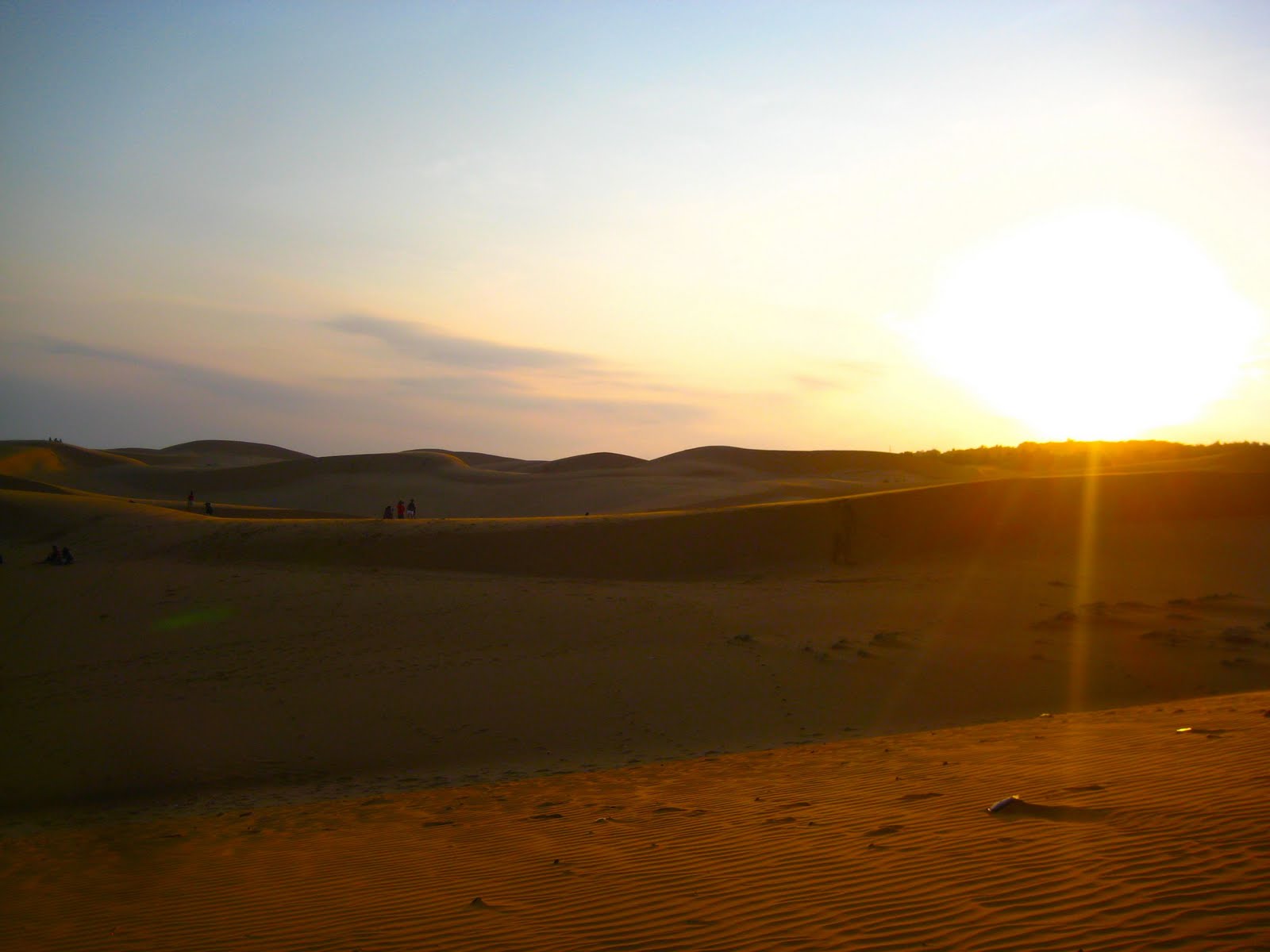
The first night I go to the Red Dunes, twenty minutes outside of town, to watch the sunset. The second the rust-colored dunes are within my sights, a team of young Vietnamese children rushes out into the streets, stopping my bike. In the small community that lives adjacent to the dunes, adult shopkeepers compete over selling refreshments and snacks while the kids vie for tourguide opportunities. As it's a quiet day, I am joined by five young guides, none of whom can be over eight years of age. The rent me a sand surf board, which is essentially a large flimsy sky blue plastic place mat with a few thick ropes tied to the front for handles. Posse in tow, we begin the climb the dunes, whose sand is surprisingly cool despite guide book warnings. We spend hours sand surfing, with my guides instructing me on perfect form and leading me to the tallest dunes. Typically two kids will stand directly in front of my surf board and pull me off the dune's edge, falling to the side at the last minute, while another two kids will stand behind pushing me down. The fifth will typically stand there and ask for tips. The surf down isn't fast, but it's still a major adrenaline rush. Especially as the sun sets over the dunes and transforms the sky into a lush watercolor painting. In addition to the obvious endorphin rush, the experience is analogous to bathing in sand. After the just two runs, my entire body is drenched in thick red sand that is simply not coming off. A sand facial as some have called it. Good news, however, is that I look dramatically tanner. My guides are lunatics -- sprinting through the sand, performing somersaults down the dunes, complaining about girlfriends despite not yet reaching double-digits, and relentlessly haggling for more tips. Due to the onslaught of sand, my camera lens is barely opening: Reason #847 I should've bought a shockproof, dirt-proof, waterproof camera.


Mui Ne's White Dunes are even more impressive: A sprawling array of light beige dunes surrounded by lakes filled with magenta desert roses. Its a confusing hourlong motorbike trip to get there, so I'm lucky Avital, an Israeli at my hostel who looks like a librarian, has chartered a motorbike to take her there for sunrise. I follow along in the pitch dark, slightly slower at 60MPH, trying not to fall. We reach the White Dunes just as the sun is rising. We basically have the dunes to ourselves apart from a couple taking wedding photos at one summit and a few others riding ATVs. Wedding pictures set in the rising sun over vacant white sand dunes in Southern coastal Vietnam? How cliche.


Mui Ne sand dune wedding


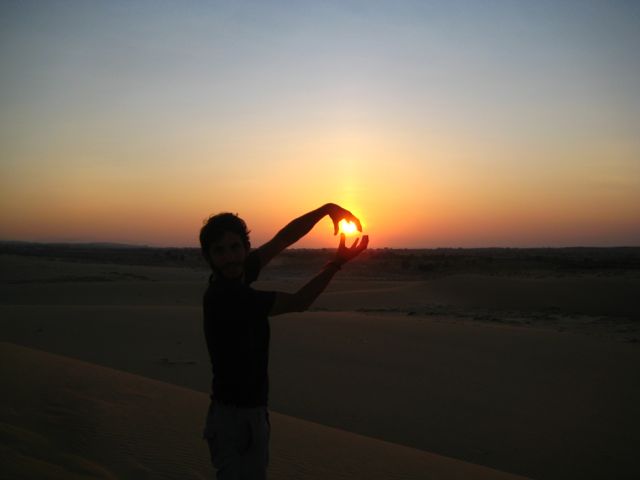
Avital and I sit atop one of the dunes and watch the glowing yellow orb rise and paint the empty white canvases in a golden light. When the sun rises, we spend the morning sledding and surfing down the peaks. It's an adrenaline rush far superior coffee. As this is my second day, I even try standing sand surfing, which involves leaning back and inverting half the board upwards. As with all my experiences surfing (sand or water), I fall repeatedly and display absolutely no sense of balance or coordination. However, I do manage to stay up on the board for five seconds prior to falling. Accomplishment?


On our way back to Mui Ne, we pause briefly due to a traffic jam as a farmer takes all of his cattle for a short trip uptown. At this hour, the dozens of cattle he herds likely outnumbers the vehicles on the street.


Vietnamese traffic


Our final stop of the day is at Mui Ne's Red Canyon, a shallow creek of striking reddish-orange bluffs. As with the town's Fairy Stream, Red Canyon is composed of soft clay and sandstone and Avital and I leave our mark by carving our names into the rock.


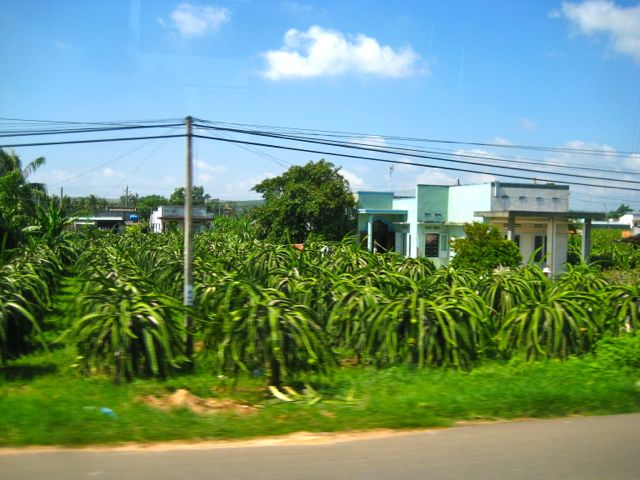
Covered in red and white sand, ostrich cooties, belly full of roasted duck, I board a 8am bus and head to Saigon. As we leave the area, we pass by Phan Thiet's many dragonfruit plantations, which look slightly like spiked aloe vera plants, with a touch of Weeping Willow, Dr. Seuss and Avatar. I think dragonfruit is only mildly appealing, almost like a bland melon, but the thrilling appearance of the plants and the fruit itself certainly promise a much more exciting taste.


Some sand surfing songs, via Sting and the Police: